


license: apache-2.0
task_categories:
  - text-generation
  - question-answering
language:
  - en
tags:
  - code
  - benchmark
  - evaluation
  - algorithms
  - systems
  - machine-learning
  - security
  - optimization
size_categories:
  - 100K<n<1M
pretty_name: Frontier-CS
Evolving Challenges for Evolving Intelligence






What is Frontier-CS?
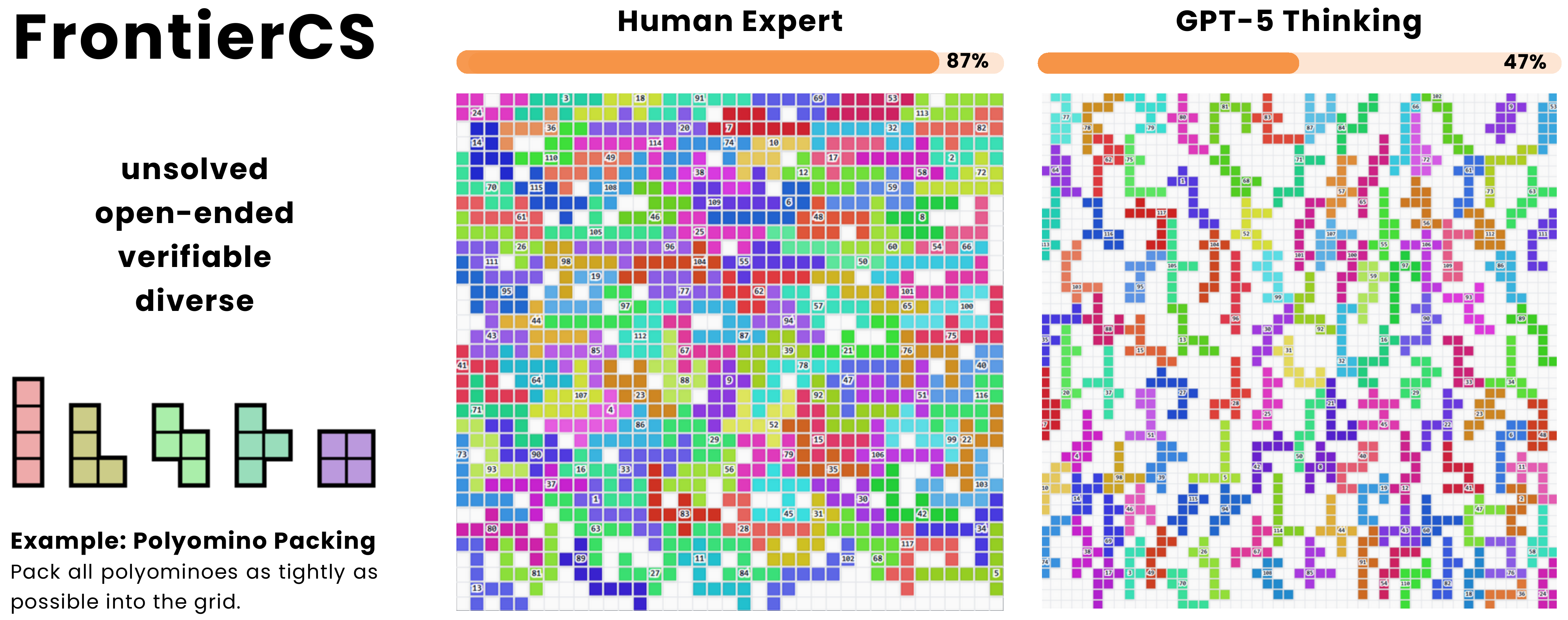
Frontier-CS is an unsolved, open-ended, verifiable, and diverse benchmark for evaluating AI on challenging computer science problems.
Think of it as an "exam" for AI, but instead of easy textbook questions, we give problems that are genuinely difficult: ones that researchers struggle with, that have no known optimal solutions, or that require deep expertise to even attempt.
Why Frontier-CS?
Current benchmarks are becoming too easy. Models score 90%+ on many existing coding benchmarks, but that doesn't mean they can actually do useful research or solve real-world engineering challenges.
Frontier-CS is different:
| Traditional Benchmarks | Frontier-CS | |
|---|---|---|
| Difficulty | Often saturated with evolving intelligence | Unsolved: no solution has achieved perfect scores |
| Problems | Textbook-style, known solutions | Open-ended research & optimization challenges |
| Evaluation | Binary pass-or-fail | Verifiable continuous scoring, always room to improve |
| Scope | Usually one domain | Diverse: systems, ML, algorithms, security, and more |
Leaderboard → | Browse example problems at frontier-cs.org
Getting Started
Installation
git clone https://github.com/FrontierCS/Frontier-CS.git
cd Frontier-CS

# Install dependencies (using uv, recommended)
uv sync

# Or with pip:
pip install -e .
Try it yourself
Here's Algorithmic Problem 0 - try to beat GPT-5!
# Start the judge server
cd algorithmic && docker compose up -d

# Run the example solution (Human Expert Solution)
frontier-eval --algorithmic 0 problems/0/examples/reference.cpp

# Run the example solution (GPT-5 Thinking Solution)
frontier-eval --algorithmic 0 problems/0/examples/gpt5.cpp

# Try you own solution!
frontier-eval --algorithmic 0 <your_solution.cpp>
Research Problems
# List all problems
frontier-eval --list

# Evaluate a generated solution locally for flash_attn problem (requires Docker)
frontier-eval flash_attn <your_solution.py>

# Evaluate on cloud (requires SkyPilot)
frontier-eval flash_attn <your_solution.py> --skypilot
See research/README.md for full documentation.
Algorithmic Problems
# Start the judge server
cd algorithmic && docker compose up -d

# Evaluate a solution
frontier-eval --algorithmic 1 <your_solution.cpp>
Raw Score
Frontier-CS supports unbounded scoring for algorithmic problems, enabling open-ended evaluation compatible with algorithm evolution frameworks such as OpenEvolve.
# Get unbounded score (without clipping to 100)
frontier-eval --algorithmic --unbounded 1 <your_solution.cpp>
Note
- We currently support C++17 only for algorithmic problem solutions.
- Reference solutions and hidden tests are withheld; full evaluation and leaderboard inclusion require submission.
See algorithmic/README.md for full documentation.
Python API
from frontier_cs import FrontierCSEvaluator

evaluator = FrontierCSEvaluator()

# Evaluate a research problem
result = evaluator.evaluate("research", problem_id="flash_attn", code=my_code)
print(f"Score: {result.score}")

# Evaluate an algorithmic problem
result = evaluator.evaluate("algorithmic", problem_id=1, code=cpp_code)
print(f"Score: {result.score}")

# Get unbounded score for algorithmic problems
result = evaluator.evaluate("algorithmic", problem_id=1, code=cpp_code, unbounded=True)
print(f"Score (bounded): {result.score}")
print(f"Score (unbounded): {result.score_unbounded}")
Submitting Results
We release partial test cases so you can develop and debug locally. For full evaluation and leaderboard inclusion, submit your solutions to [email protected], or [email protected], or [email protected] following the instructions in SUBMIT.md.
Questions? Join our Discord
Acknowledgments
Some problems are adapted from ALE-bench and AI-Driven Research for Systems (ADRS).
Citing Us
If you use Frontier-CS in your research, please cite: